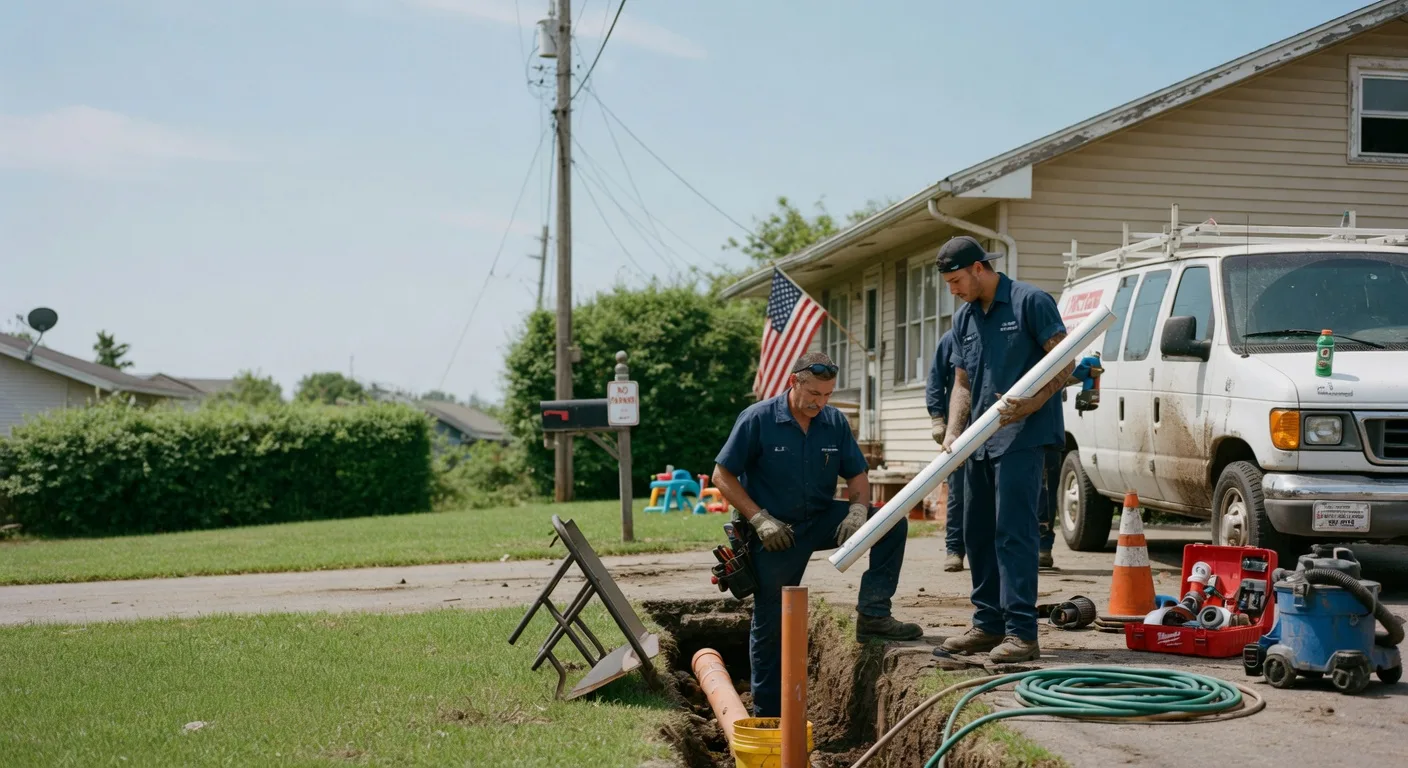
What is a bellied or sagging sewer line, and can it be cleaned?
A belly is a low spot in the sewer line where the pipe has sunk. Water and waste stop and sit in the dip instead of flowing on. Solids settle there, grease coats the pipe wall and paper catches. You see it as drains that run slow, a toilet that needs repeated flushing, or a line that clogs again a few weeks after it was cleared.
The cause is usually a pipe that lost support underneath it, or a joint that shifted.
Can it be cleaned? Yes, up to a point. A cable machine can open a blockage sitting in the belly, and hydro jetting can wash grease and buildup off the pipe wall. Neither fixes the dip. The belly keeps holding water, so the buildup returns.
A camera inspection tells you the rest. It shows how deep the belly is, whether the pipe is cracked, and whether roots have entered a joint. Cost depends on how deep the line is, how much has to be dug up or removed, the materials involved and any permit.
Safe homeowner check: note whether one fixture or the whole house is slow. One fixture points to its own branch. Every drain slow points to the main line.
Stop running water and call now if sewage is coming up in a tub, shower or floor drain.
Expert Plumbers Co is a referral service. Call (380) 262-9173 and we will connect you with a plumber serving Buxton, OR for Drain Cleaning or Emergency Drain Cleaning.
Left alone, a belly tends to get worse in a predictable way. The standing water softens the soil around the pipe further, the dip deepens, and the clogs come back faster each time. Another warning sign is a faint sewage smell in the yard or a patch of lawn that sinks or stays wet, which can mean the pipe has separated at a joint. Older homes with clay or cast iron lines are the most likely to have a belly, because those pipes sit in sections and shift as soil settles. Newer plastic lines can also sag when the trench bedding was uneven. When you speak to the plumber, ask what the camera shows about the depth of the dip and the condition of the pipe at that spot. If the pipe is intact, a spot repair may be possible. If it is cracked, replacing that section is the lasting fix.
My shower drains slowly. What should I check before calling?
A shower that drains slowly is usually a single fixture problem, and that matters. Hair and soap scum catch in the strainer and the trap just below it. That is a different job from a main line problem, where every drain in the house runs slow.
Safe checks you can do yourself: lift the strainer or stopper and clear what is sitting on it. A plastic drain strip, the kind with small barbs, pulls hair out of the first few inches of pipe. Flush with hot tap water afterwards. Then test the others. Run the bathroom sink and flush the toilet while watching the tub. If water rises or bubbles in the tub, the problem is past this fixture.
Chemical drain openers are best avoided. They sit in a standing pipe, can damage fittings, and are a hazard to whoever opens the line next.
Stop running water and call if the toilet gurgles when the shower empties, if there is a sewage smell, or if water comes up in any drain. Gurgling can point to a blocked vent stack, and slow drains everywhere can point to the main line.
A cable machine is usually enough for hair and soap in a branch line. If it keeps coming back, a camera inspection shows why. Expert Plumbers Co is a referral service, not a plumbing company. We refer you to a local plumber for Drain Cleaning in Buxton, OR: (380) 262-9173.
One more thing to check is whether the problem is the shower drain itself or the pipe it sits in. If the strainer is clear and the water still pools, try removing the cover and looking at how the drain body is built. Some tubs have a pop-up stopper or a trip lever linked through the overflow, and a bent or hair-wrapped linkage can hold the plug partly shut. In older homes the tub may use a lead or cast iron trap further down that fills with soap and hair, while newer showers have a plastic P-trap that is easier to reach from below. A common mistake is pouring boiling water down the drain, which can soften plastic fittings and loosen joints. If the water level drops only after a long wait, even once the strainer is clean, the blockage is deeper in the branch and needs a plumber's tools.
My sink gurgles after it drains and someone mentioned an air admittance valve. What is that, and can it fail?
"My sink gurgles after it drains" is one of the most common things people notice before a drain problem gets worse. Every fixture needs a vent so water leaving the trap does not pull a vacuum. When air cannot get in, it gets dragged through the trap water instead, and that is the gurgle.
An air admittance valve, or AAV, is a small one-way valve fitted on a vent pipe, often under a sink or in an attic. It opens to let air in as water drains, then drops shut so sewer gas stays in the pipe. Many local codes allow them and some do not, so rules vary by area.
Yes, they can fail. The rubber seal wears, dust or debris stops the flap seating, or the valve sticks. A valve that will not open brings back the gurgling and slow draining. One that will not close lets a sewer smell into the cabinet or room.
A blocked vent stack on the roof, a partial clog in the drain, or a bellied line holding water can also cause gurgling. One gurgling fixture usually points to its own trap, branch line or vent. If the tub, toilet and floor drain all gurgle together, or the toilet bubbles when the washer empties, suspect the main line or the main vent.
Safe homeowner check: Run just the gurgling sink and listen, then run another fixture and see if it does the same. Do not pry at vent parts inside walls, and do not pour drain chemicals into a line that is already gurgling.
Stop running water and call now if sewage smell is strong, water comes up in a tub, shower or floor drain when you use another fixture, a toilet bubbles or rises, or any fixture stops draining.
A cable machine is usually enough for a clog in a single branch line, like the pipe behind one sink. If the gurgle returns, or several fixtures are affected, the plumber may want a camera inspection to look for root intrusion at a clay joint, a bellied line, or a failing section. A blocked roof vent is cleared from the roof, not with a drain cable.
Expert Plumbers Co is a referral service. We connect you with an independent local plumber in Buxton, OR. Call (380) 262-9173.
Ask the plumber whether an AAV is permitted where you live, or whether a conventional vent is needed instead. Cost depends on access to the pipe, the parts or materials needed, how much wall or ceiling has to be opened, and any permit or code requirement.
Will baking soda and vinegar, or a kettle of boiling water, clear a slow drain?
You have a slow drain, so you tried baking soda and vinegar, or a kettle of boiling water. It still crawls, or the clog is back by morning. That is the usual result.
The fizz is mild. It can freshen a drain, but it does nothing to a solid clog of hair, soap scum, grease or paper. Boiling water melts grease for a moment, then the grease cools and sets again further down the pipe, where it is harder to reach. Boiling water can also soften PVC joints and crack porcelain. Hot tap water is safer than a kettle.
The real causes sit deeper: grease build-up on the pipe wall, scale in old cast iron, roots entering a clay joint on the main, or a bellied line that holds water and solids at its low point. A blocked vent stack can also make a drain sluggish and gurgling, which looks like a clog but is an air problem.
Count the affected drains. One slow fixture usually means a hair, soap or grease clog in that fixture or its branch. If the tub, sinks and toilets all run slow together, or you hear gurgling after a flush, the trouble is in the main line or vent, and no kitchen remedy will reach it.
Safe homeowner check: Remove the stopper or strainer and clear hair and residue by hand. Try a plunger with a good seal. Run hot tap water, not boiling. Check whether other fixtures are slow. Avoid stacking store-bought chemical cleaners, which can sit in a standing pipe.
Stop running water and call now if more than one fixture is backing up, if dark water is rising in a tub or floor drain, if you smell sewage, or if water comes up when you flush or drain the washer.
A cable machine is usually enough for a clog in a single branch. Hydro jetting is the better tool when grease or scale coats the pipe wall. A camera inspection is the right step when the drain clears and slows again within days, since that pattern points to a belly, roots or a damaged section.
Expert Plumbers Co is a referral service. We connect you with an independent local plumber in Buxton, OR. Call (380) 262-9173.
Tell the plumber what you already tried. Ask what they found in the line, not only that it was cleared. The scope depends on access to the pipe, whether a fixture has to be removed, the pipe material, and whether the cause is a simple clog or damage that needs repair.
My bathtub has a lever on the overflow plate and it drains slowly. Where is the clog?
Your tub has a lever on the overflow plate, the one you flip to close the drain, and now the water sits around your ankles. It drains slowly, and you want to know where the clog is. It is usually in one of two places.
Trip-lever drains have a plunger, or a stopper and linkage, that runs down inside the overflow tube behind that plate. A rod and spring connect the lever to the stopper at the bottom. Hair and soap scum wrap around that linkage and build into a mat that restricts the opening, even when the tub looks empty. If the linkage is out of adjustment, the stopper may also sit partly closed, so water slips through a narrower gap than it should.
The second place is the trap below the tub. Most tubs use a P-trap, and that bend collects hair, soap, and grease from bath oils. A clog there slows the whole tub even when the linkage is clean.
If only the tub is slow and the sink and toilet in the same bathroom work, the clog is almost certainly in the linkage or the trap. If the sink, shower and toilet also run slow, or the tub gurgles when another fixture drains, the problem is in the branch or main line.
Safe homeowner check: unscrew the overflow plate, pull out the linkage slowly, and clean off the hair and gunk. Check that the lever lifts the stopper fully. Run hot tap water, not boiling, to flush the drain. Avoid chemical openers.
Stop running water and call now if water backs up in the tub when the toilet or sink is used, if you see sewage, if there is water on the floor or ceiling below, or if a strong sewer smell shows up with the slow drain.
A cable machine is enough for a hair clog in the trap or a short branch. If the tub keeps slowing down, or several fixtures are involved, a camera inspection shows whether the cause is roots, a belly or grease coating the pipe. Hydro jetting is worth considering when the pipe wall is coated rather than plugged.
Expert Plumbers Co is a referral service. We connect you with an independent local plumber in Buxton, OR. Call (380) 262-9173.
Ask the plumber whether the clog was in the linkage, the trap or further along, and whether the stopper needs replacing or adjusting. If the tub sits over a finished ceiling or is set in tile, ask how they plan to reach the trap. The scope depends on access, the parts or materials needed, how much has to be opened up, and any permit or code requirement.